


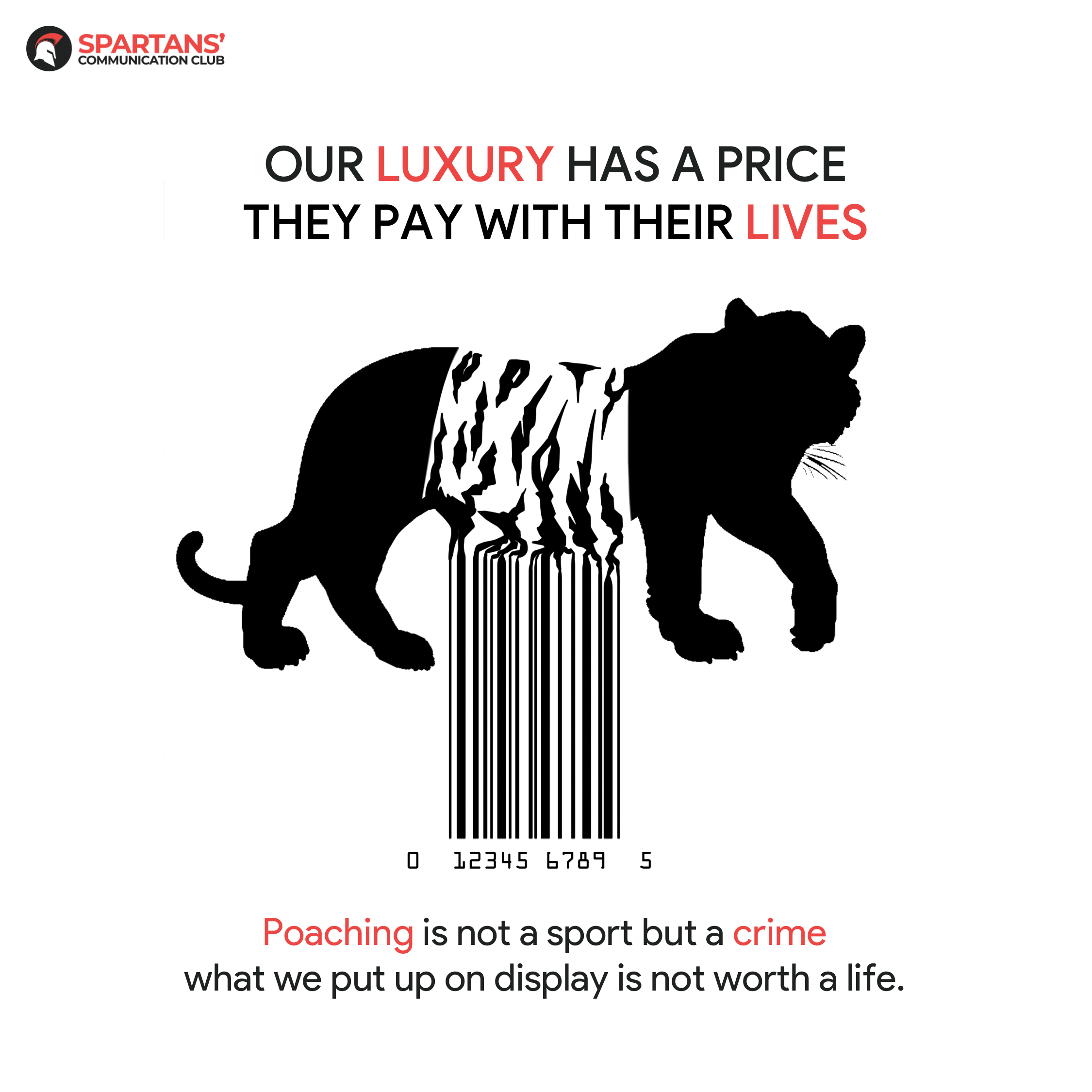
Today marks exactly 13 years since the UN declared December 4th as International Wildlife Conservation Day. As it looms in on us once again, we at Spartans’ Communication Club would take a moment to raise awareness against one of the most desired yet heinous acts of cruelty committed against one of our most globally lauded national treasures, the poaching of the Royal Bengal Tiger.
Bangladesh, unfortunately, has long been one of the major countries involved in the illegal trade of tiger parts, particularly fulfilling demands from over 15 countries, including India, China, Malaysia, the U.K., Germany, Australia, and Japan. Tiger bones, teeth, raw meat, and, of course, their skin have long been a sought-after product that were often smuggled through Bangladesh’s airports or seaports. To make matters worse for this magnificent creature, a newly booming elite portion of our economy has also set its sights on tiger parts, particularly tiger skin, for its inherent status as a luxurious showpiece. As the rule of economics follows, this demand needed to be met with adequate supply, and eventually, a domestic market for illegal tiger parts trading also took root.
However, conservation efforts weren’t fully futile, as there has been a reported decline of around 75% in poaching from 2018 to 2021. As of 2024, 125 Royal Bengal Tigers are currently roaming the Sundarbans, representing a 9.65% increase in population since 2018, when there were 114. But their survival is still not completely free from danger, as predatory practices over the commercialization of their body parts are still an ongoing concern. As our economic progression strengthens the spending position of certain groups, poaching to meet luxurious needs is still out there at large.
But we can still make a difference and help this species maintain its existence while enriching our biodiversity by enforcing stronger safeguards and penalties against the poaching of wild animals for reasons as unnecessary as exhibition. This also goes without saying that our mindsets themselves need to improve regarding what we view as a status symbol of affluence. It is not a stretch to state that a luxurious display should not come at the cost of a life in any way, shape, or form.
Author